

Subscribe from $5.99
0,00 USD

No products in the cart.

Technology in Schools: New Report Outlines K–12 School Safety Trends

Advertisement

CENTEGIX®, the largest wearable safety technology provider for K–12 education, today released its 2024 School Safety Trends Report. Unique to the panic button market, the report offers a comprehensive analysis of school safety incident trends observed during the 2023–2024 academic year through data collected from the CENTEGIX Safety Platform™.

CENTEGIX solutions are utilized by 800+ districts nationwide. The flagship of the CENTEGIX Safety Platform is CrisisAlert™, a wearable panic button solution with dynamic incident mapping. Safety Blueprint™ displays digital campus maps and school safety assets and provides real-time locating features for incident response and visitor management.
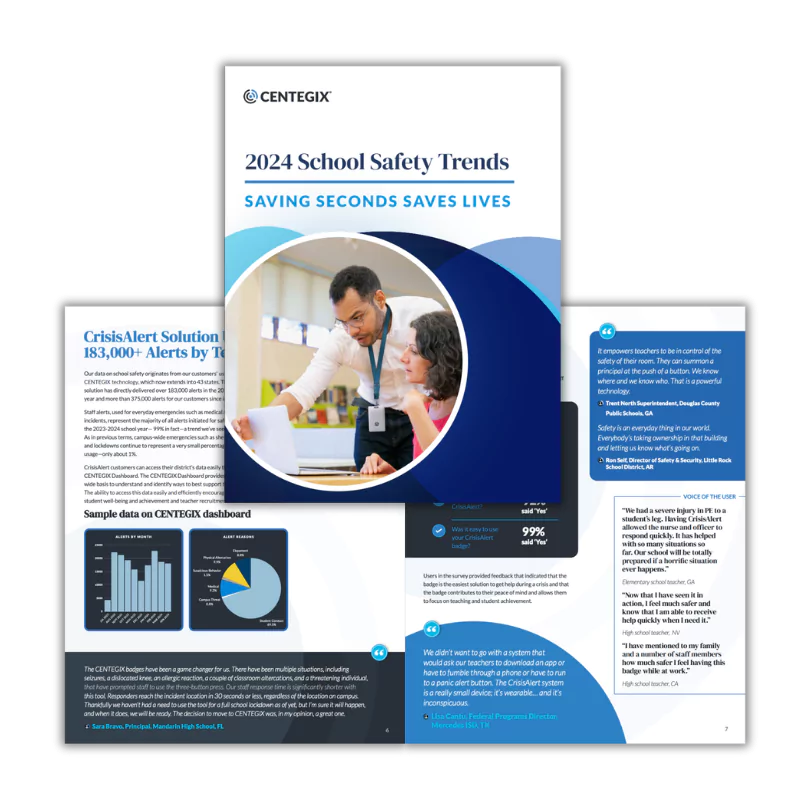
A collection of images that show the cover page of CENTEGIX's "2024 School Safety Trends" report and one of the report's inner pages.
Image provided by CENTEGIX

Key Highlights

  • Over 10 million people across the U.S., including students, educators, and staff, are protected by CENTEGIX. There’s a 45% increase in users since January 2023.

  • Educators and staff initiated over 183,000 alerts this school year. This indicates a 40% increase compared to the previous year—suggesting a shift away from mobile phone apps to wearable panic buttons by staff members.

  • 99% of all alerts are for everyday emergencies, such as medical and behavioural incidents. Campus-wide incidents such as lockdowns and shelter-in-place continue to represent a small percentage of total alerts.

  • More than 50% of school safety incidents occur outside the classroom such as hallways, parking lots, or sports fields, highlighting the importance of precise location information for an emergency response system. First responders need to know exactly where help is needed to reduce response time.

Prioritizing Safety

“We’re working with hundreds of districts across the country to improve school safety, and our technology continues to have a significant impact on everyday incidents and emergencies. The badges are used by staff every day to de-escalate altercations, to get life-saving devices to medical emergencies, and to provide staff with support when it’s needed,” said Brent Cobb, CEO of CENTEGIX.

A teacher and a high school student are walking down a school hallway. The teacher is wearing the panic button on a lanyard around his neck.
Image provided by CENTEGIX

“The kind of incident response solution you equip your staff with can significantly impact the outcome in a crisis situation. Schools across the U.S. have recognized the power of a multilayered approach to safety, choosing the CENTEGIX Safety Platform as the foundation for their school safety plan. Our platform is accelerating responses to emergencies and saving lives in the process.”

Meade County School District, KY, Teacher Michele Miller describes their first event that occurred two weeks after CrisisAlert was implemented. “There were probably about four of us in the general area of where this [emergency] occurred, and I think all four of us ended up pushing our button and within a matter of seconds, three administrators showed up at the location, directly at the location and took over the situation. I’ve been here 18 years, that just doesn’t happen, that’s the quickest response I’ve ever seen.”

With CENTEGIX, K–12 teachers and staff are empowered to respond to any incident—from the every day to the extreme—anywhere on campus. Learn more about 2024 School Safety Trends: Saving Seconds Saves Lives and download the full report.


About CENTEGIX

CENTEGIX is the industry leader in wearable safety technology for K–12 education with over 600,000 badges in use. To learn more about CENTEGIX, visit www.centegix.com.

TEACH is the largest national education publication in Canada. We support good teachers and teaching and believe in innovation in education.

Education News

ReadBright Literacy Tools Earn Bronze Efficacy Certification from EduEvidence

This independent certification recognizes that ReadBright aligns with the Science of Reading and meets rigorous standards for evidence-based instructional design.

Teaching Children to Be Better, More Critical Internet Users

McGill researchers designed and then tested a program that was shown to improve elementary students’ digital literacy skills.

Common Sense Media Launches Youth AI Safety Institute

The first-of-its-kind AI safety lab focused on children will independently test AI products, broadly publish the results, and set clear standards to protect the safety, health, and development of a generation growing up with AI.

Providing Easy Access to Curriculum-Aligned Indigenous Resources

Ontario’s Niagara Catholic District School Board and Nelson partnered together to support educators who are teaching subjects with Indigenous content.

Controlled Chaos: Lessons in Laughter, Growth, and the Magic of Teaching

“Controlled Chaos” is a collection of stories that will have you in stitches, feeling inspired, and questioning the very idea of what “normal” looks like in education.

Updated Guidance on Responsible Use of Technology in Schools 

The third edition of “Setting Conditions for Success” reflects evolving expectations around AI, student well‑being, and digital citizenship.
TEACH Mag
TEACH Mag
TEACH is the largest national education publication in Canada. We support good teachers and teaching and believe in innovation in education.

Advertisement

Advertisement

Read More

ReadBright Literacy Tools Earn Bronze Efficacy Certification from EduEvidence

This independent certification recognizes that ReadBright aligns with the Science of Reading and meets rigorous standards for evidence-based instructional design.

Mental Health and Student Attendance: The Intervention Hiding in Plain Sight

A punitive response to a late or absent student, the recorded tardy, the “you’re late again,” doesn’t just fail to help. It adds to the weight a struggling student is already carrying.

Murdoch is Cracking the Case on Student Engagement

Murdoch in the Classroom offers a fresh, distinctly Canadian way to bring story-led, curriculum-connected learning into the classroom.

How Slam Poetry Transforms the FSL Classroom

My FSL classroom is rarely quiet. There’s laughter, music, performance, and sometimes a bit of chaos, but it’s the productive kind. On poetry unit days, students sit congregated in groups, and they transform the space into a “scène de slam.”

Act 47 Is a Promising Start—Now Pennsylvania Must Get It Right

With Act 47 of 2025, the state is advancing towards stronger reading instruction by mandating evidence-based curricula, regular screening in early grades, improved educator training, and intervention plans for struggling students.

8 Ways to Build a Creative Classroom

Creativity isn’t innate—it’s a cognitive skill that all students can develop with time and the right opportunities. While cultivating a creative classroom may seem intimidating, it doesn’t have to be.