By Jehanne Dubrow
For the past two decades, I’ve been reading, writing, and teaching about how poets try to depict the experience of trauma through verse. Although some people might think that this would be sad or depressing work, in my experience, it can be tremendously inspiring to encounter art that uses skill, intelligence, emotion, and creativity to capture the most frightening parts of what it means to be human.
More recently, I’ve seen how many of my students want to write about their traumas in poems. And I’ve also seen how difficult this process can be for them, how challenging it is to write a poem that fully captures both the immediacy of pain and its aftermath.
That’s why I decided to write The Wounded Line. I wanted to offer my students a helpful guide, a kind of roadmap for exploring a traumatic event through their poetry.
The book discusses reasons why it can be so hard to write about trauma. It also offers readers foundational information about trauma studies, provides more than twenty practical strategies for drafting a poem that engages with trauma, and includes nearly sixty generative writing prompts.
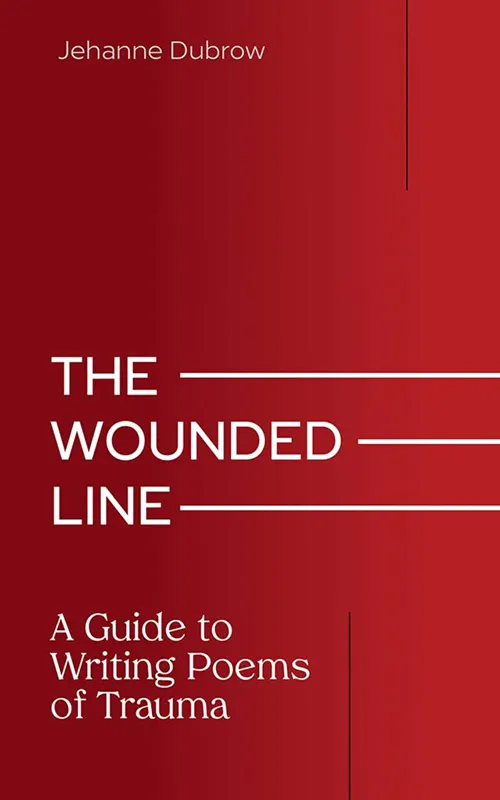
I wrote The Wounded Line with the struggles of my students in mind. I teach undergraduates and graduate students, as well as older poets navigating these questions on their own, outside of an academic setting. But the essential lessons of this book can also be used to help younger writers in high school who wish to use poetry to tell their wounded stories.
Among the concrete techniques I discuss in the book, one of my favorites to introduce to beginning poets is the use of list-making. As I explain in a chapter dedicated to lists and catalogs, “Sometimes, in response to trauma, the mind organizes. It tries to keep itself within strict boundaries. It looks for forms of containment. In a list poem—a poem that is structured as a catalog of objects, people, places, things—the act of ordering becomes a way to assert control.”
A poem that is structured around the act of list-making can convey the sensation of being inside a mind that’s traumatized, a mind that wants to order the chaos of the world as a means of controlling its own suffering.
And, in another chapter, I discuss how fragmentation can express the way grief, loss, and trauma can often split us into many tiny pieces. I write that, “After trauma, we are often made incomplete, and the poem’s task is to embody the hollows left behind.”
I then offer recommendations for writing poems that mimic this brokenness on the page. This can include using sentence fragments, incorporating lots of white space in the lines, and even shifting rapidly from image to image so that the poem’s thinking is broken into shards.
We all experience pain, and many of us long to transform that hurt into artful, compelling language. I hope The Wounded Line will be helpful to poets of all ages, whatever their grief, loss, or trauma.

Jehanne Dubrow is the author of three books of non-fiction and ten poetry collections. Her writing has appeared in New England Review, The Southern Review, and Ploughshares. She is a Distinguished Research Professor and a Professor of Creative Writing at the University of North Texas.