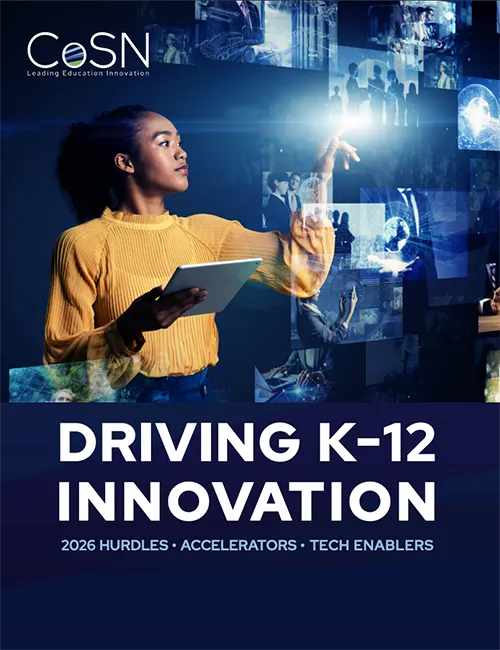
CoSN, The Consortium for School Networking recently released its annual 2026 Driving K–12 Innovation report, identifying the top “Hurdles” (challenges) schools must overcome, “Accelerators” (mega-trends) driving innovation, and “Tech Enablers” (tools) transforming teaching and learning this year.
Informed by an international Advisory Board of more than 130 education and technology experts, the report reflects the realities and opportunities education systems face in 2026, such as using artificial intelligence responsibly, ensuring cybersecurity and safety online, and providing intentional professional development for educators that is responsive to evolving understandings of how students learn and demonstrate knowledge.
“The report affirms a shared truth: technology will keep accelerating, but intentional innovation in K–12 education depends on the strength, creativity, and humanity of educators and IT leaders. This report invites educators and technology leaders to lead that future boldly and responsibly, and together,” said Keith Krueger, CEO, CoSN.
Hurdles Facing K–12 Education
- Attracting and Retaining Educators and IT Professionals: School districts struggle to attract and retain educators and IT professionals due to low compensation, heavy workloads, burnout, and competition from private-sector employers. Intentional investment in workplace climate, appreciation, and professional growth is key to sustaining innovation.
- Ensuring Cybersecurity and Safety Online: Schools face growing cybersecurity risks as digital tools become essential to daily operations, requiring districts to protect every user across expanding systems. Effective security depends on shared responsibility, strong policy frameworks, and a culture of care that supports safety and seamless instruction.
- Critical Media Literacy: Media literacy now requires far more than just fact-checking; it demands deep discernment, ethical judgment, and holistic digital citizenship skills. Preparing students to navigate an information ecosystem defined by speed, complexity, and misinformation requires strengthening metacognition, emotional intelligence, and responsible media creation.
Accelerators Driving Innovation Across School Systems
- Building the Human Capacity of Leaders: Investing in staff is essential to meaningful K–12 transformation, demanding deep investments in AI literacy, reflective practice, and intentional professional growth. Innovation succeeds when people (not technology) are prepared, supported, and empowered to lead change across systems.
- Changing Attitudes Toward Demonstrating Learning: Traditional tests no longer capture the depth of understanding, creativity, or real-world problem-solving skills students need, prompting a shift toward project-based, multimodal demonstrations of learning. Universal Design for Learning (UDL), computational thinking, and student-created products empower learners to show what they can do, not what they recall.
- Learner Agency: Shifting students from passive recipients to active decision-makers is key, supported by inquiry-based learning, educator agency, and structures that encourage curiosity, autonomy, and responsible technology use. Despite growing pressure to increase control, especially in response to AI, transformation depends on empowering students and teachers with the skills for future-ready learning.
Tech Enablers Shaping Classrooms
- Generative Artificial Intelligence (Gen AI): Gen AI is transforming education globally, offering new possibilities while raising concerns around responsible use, equity, and system readiness. Meaningful progress requires intentional, values-driven leadership to ensure AI amplifies human connection and deep learning.
- Data and Information Visualization: Data visualization helps educators quickly interpret complex information and respond to students’ needs, but its impact depends on the quality of the data and the culture surrounding its use. When systems and people are aligned, visualization becomes a powerful tool for clarity, equity, and informed decision-making.
- Tools for Privacy and Safety Online: Technologies that protect learner privacy and ensure safe digital learning environments form the trust infrastructure of modern education. System readiness requires shared frameworks, cross-district collaboration, and careful balancing between online access and student safety and privacy.
The report also identifies three “Bridges” (themes) that span top topics for education innovation, recognizing that progress in any one area cannot happen in isolation. The bridges include:
- Innovation without ethics erodes trust, and trust is the cornerstone of safe digital learning;
- Innovation without equity leads to widening gaps, while innovation with equity drives transformation;
- The culture of a school system determines the success of its technology.
Download the full report here.
About CoSN
CoSN, the world-class professional association for K–12 EdTech leaders, stands at the forefront of education innovation. We are driven by a mission to equip current and aspiring K–12 education technology leaders, their teams, and school districts with the community, knowledge, and professional development they need to cultivate engaging learning environments. Our vision is rooted in a future where every learner reaches their unique potential, guided by our community. CoSN represents over 13 million students and continues to grow as a powerful and influential voice in K–12 education.

TEACH is the largest national education publication in Canada. We support good teachers and teaching, and believe in innovation in education.