A group of students at a school in Singapore looked around their cafeteria and realized just how much Styrofoam they used at lunch. Among 2,000 students, they estimated their student body was using 72,000 disposable pieces of plastic every year.
They asked themselves, if that’s how much disposable plastics were being used in one school community, how much could their country possibly be using every year? What about around the world? And, how can a small group of students make a big difference?
What started as a series of simple questions became a student-led movement that translated intrigue into action.
Scaling this spirit of curiosity is at the core of the National Geographic Society’s approach to education, and a pillar of Unplastify’s flagship program, the Unplastify Challenge for Schools, which just celebrated the conclusion of its 12th edition in February.
Eradicating Single-Use Plastic
The Unplastify Challenge is an international educational program in both Spanish and English that is designed to empower 15- and 16-year-olds to actively engage in the global plastic problem. Unplastify was built on the idea that the key to a healthier ocean and planet is not plastic recycling, but plastic use prevention. In practice, this means students examine where single-use plastics appear in their daily routines—such as takeaway containers in the cafeteria, or the packaging of classroom supplies—and work to identify sustainable alternatives that shift the human relationship with plastic.
“It’s easy to feel powerless in the face of such a huge problem, but we refuse to accept that inaction is the only option,” said a member of the Singapore student team during the 12th edition of the Unplastify Challenge, as they presented the successes of their bring-your-own-box campaign incentivizing students to bring reusable containers to school.
Guided by educator-mentors, the Challenge invites young people from all over the world to devise, develop, and implement a strategy to eradicate single-use plastic from their community. The program is designed as a competition with regular assignments, reflection points, and workshops where students receive scores and feedback. At the end of the program, the student teams with the highest scores present their projects to a jury of experts at a closing community event.
“It’s truly remarkable to see what students can come up with when they’re empowered to tackle issues important to their communities,” said Agustina “Tati” Besada, Unplastify co-founder and National Geographic Explorer. “Unplastify teaches young people the process of solutioning while providing them with the tools they need to enact their ideas. Their energy and ingenuity to create positive change is palpable, and I truly believe this program sets learners up for success, no matter what path they pursue later in life.”
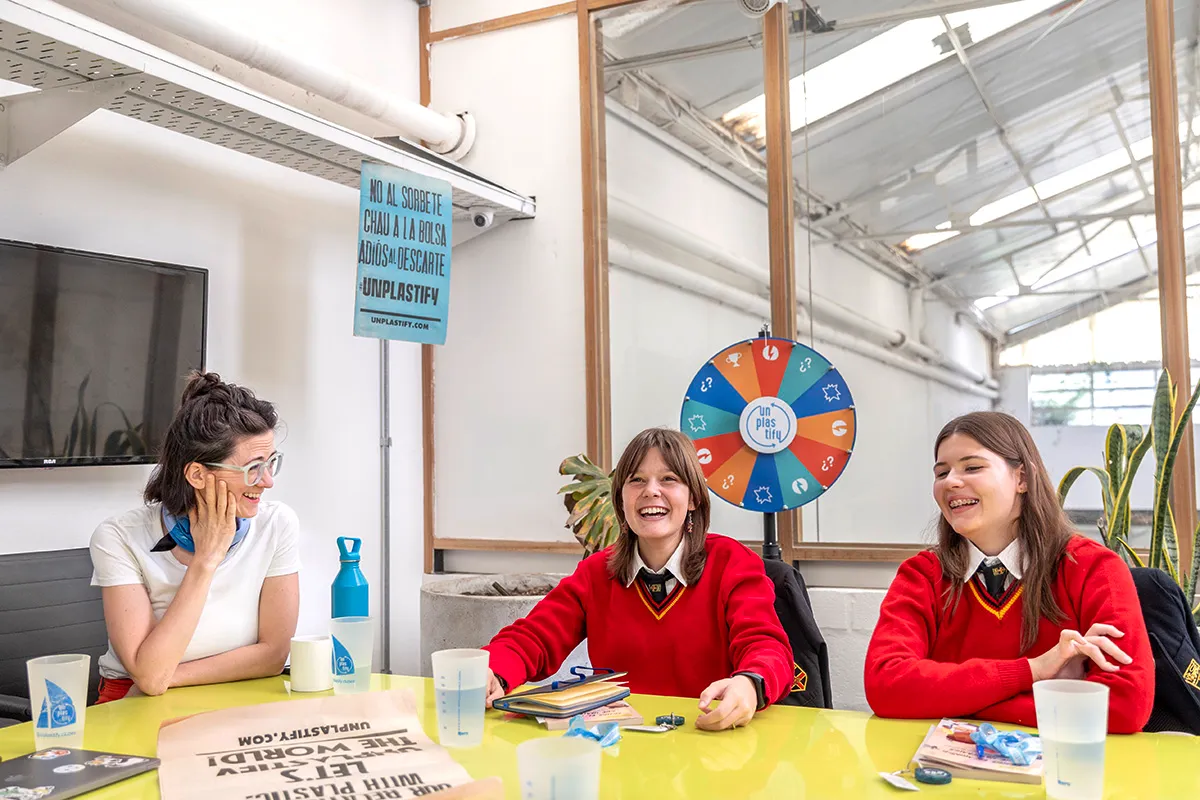
Agustina “Tati” Besada and the Unplastify Team in their coworking space in Buenos Aires, Argentina, alongside the school winners of the Unplastify Challenge. Photo by Sofia Lopez Mañan/National Geographic.
With support from the National Geographic Society over the last three years, the Unplastify Challenge for Schools has engaged student teams in 31 different countries. From eco-friendly phone cases and natural deodorants to replacing plastic wrap and sponges with natural solutions, student teams around the world have sparked real change in their communities. In 2025 alone, over 650 students across 55 schools came up with 141 “unplastified” strategies that helped avoid 13.9 tons of plastic.
Supporting Educators
The team behind Unplastify says the program relies on engaging educators, who also serve as mentors. For Unplastify, education is not about giving students solutions, but about empowering them to discover their own. The program combines innovative and established educational methodologies to create real-world impact, including project-based learning, learning by doing, design thinking, and iteration.
In addition to directly supporting educators through classroom implementation, the Unplastify Challenge program ensures educators have the resources, training, and frameworks they need to feel prepared and supported throughout the duration of the program. The Challenge also connects them to a global network of educators who are all committed to empowering young people to create environmental and social change.
“This was the first year my classes joined the Unplastify Challenge and it was a fantastic experience,” said Alexia Dosal, a 12th edition Unplastify Challenge mentor and an educator at Liceo Franco Mexicano in Mexico City, Mexico. “It was very rewarding to see the students create tangible projects that go beyond the classroom setting. It was also very motivating for them. I am looking forward to participating again next year.”
Learners as Changemakers
While many environmental education programs focus on awareness, the Unplastify Challenge is unique in that it creates a learning pathway to position learners as positive changemakers for the rest of their lives. The program empowers students to cultivate skills that extend far beyond sustainability: collaboration, leadership, systems thinking, creativity, and resilience. This approach reinforces the idea that education is not about providing students the answers for today, but about fostering the autonomy and agency for them to discover their own solutions for tomorrow.
The next Unplastify Challenge for Schools edition, Spanish-language, kicks off later this year. Stay up to date on registration information at www.unplastify.com.
About Unplastify
Unplastify is a social enterprise on a mission to change the human relationship with plastic, accelerating systemic changes to minimize the use of single-use-plastic. Based in Latin America, Unplastify works on educational programs with youth, transformative projects with companies, and advocacy for new public policies with governments. Unplastify was co-founded by Agustina “Tati” Besada after she crossed the Atlantic Ocean in a 36-foot sailboat—twice—to research ocean plastics and to study international scalable solutions. She transformed this adventure into action by co-founding Unplastify, which also works with non-profit organizations, governments, and regional platforms to promote responsible production systems, resource efficiency, and circular economy.
About the National Geographic Society
The National Geographic Society is a global non-profit organization that uses the power of science, exploration, education, and storytelling to illuminate and protect the wonder of our world. Since 1888, National Geographic has pushed the boundaries of exploration, investing in bold people and transformative ideas, providing more than 15,000 grants for work across all seven continents, reaching three million students each year through education offerings, and engaging audiences around the globe through signature experiences, stories, and content.
The National Geographic Society supports a number of programs for youth, including the Slingshot Challenge, National Geographic Photo Camp, the National Geographic Society and The Nature Conservancy Externship, the Young Explorers Program, and Explorer Classroom.
Feature image by Sofia Lopez Mañan/National Geographic

TEACH is the largest national education publication in Canada. We support good teachers and teaching and believe in innovation in education.