Subscribe from $5.99
0,00 USD

No products in the cart.

Beyond the Map: Engaging with Complex Histories to Support Critical Place-Based Learning

Advertisement

By Matthew Panozzo, Lara Condon, Keishana Barnes, Anna Falkner, and Carolyn Michael-Banks “Queen”

In 2005, the novelist David Foster Wallace gave a commencement speech at Kenyon College, Ohio. During that speech, he observed that “the most obvious, important realities are often the ones that are hardest to see and talk about.”

We live and work a few states south of Ohio, in Memphis, Tennessee, yet this statement resonates deeply with us. Our city’s narrative is filled with competing, conflicting stories of space and place, but these layered histories often fade into the blur of our everyday routines.
Do we talk enough about the assassination of Dr. Martin Luther King, Jr. and how it still lingers in the air? Do we discuss slavery and the Trail of Tears, and how these shaped our early economy and the city’s development? Do we ever mention Elvis and B. B. King? As teacher educators, we are rarely asked to sit with these histories and consider how they influence our pedagogy, curriculum, and relationship with the community.

Last year, we were junior faculty members at the University of Memphis, each with different backgrounds and relationships to the city. Some of us had already laid roots, while others were recent transplants. At the end of the semester, our department chair wanted us to all connect with our city, so she signed us up for A Tour of Possibilities—a guided tour of African American history in Memphis, run by Carolyn Michael-Banks, aka. Queen.

Our task for that morning: “Have a good time learning about some of Memphis’s jewels, debriefing, de-stressing, and bonding.”

Through Queen’s tour, we had the opportunity to slow down and grapple with our city’s complex past. It was only a glimpse into key places, but it gave us the time to think and pay attention to the details—the ones in plain sight, the ones hidden, and even the ones erased. This tour had a duality to it, balancing harm and hope, limitations and liberation, past and present.

In this article, we would like to share how engaging with our local community informed our understanding of the lived realities and histories of those we serve in schools. This ultimately helped us view the city, our teaching, and our research in a new light, and we hope our story encourages other educators to engage with their schools and communities in a similar way.

Critical Place-Based Pedagogy

Inspired by Black and Indigenous pedagogy that honors the history of place (e.g. Douglas & Peck, 2013; Johnson, 2012), we began to consider the role that a critical place-based pedagogy might play in our practice. A critical place-based pedagogy, as described by David A. Gruenewald, asks students to develop an intentional consciousness of place that can lead to exploration, inquiry, and social action.

To fully implement a version of this that honors the identities and lived experiences of our community, we engaged in three key processes: embracing tension through self-reflection, unpacking tension through dialogue, and understanding tension as the catalyst for elevating local knowledge. 

Embracing Tension

To talk about justice, we have to expose injustice. To talk about equity, we must admit when inequities are present. These conversations have the potential to cause tension, but we can’t shy away from them, as tension is a part of the learning, healing, and changing process.

Memphis carries a weight that is both historical and spiritual. It is the city where Dr. Martin Luther King, Jr. gave his final speech, and through that, the city inherited both the pain of his assassination and the promise of his vision. This legacy asks something of us.

During our guided tour, we paused in front of the Mason Temple, the place where Dr. King delivered his “I’ve Been to the Mountaintop” speech. We stood there quietly, absorbing its significance as Queen played a clip of the speech. Listening, it reminded us that our teaching carries forward the unfinished work of justice and social change. As educators, we see our classrooms as spaces where students can deepen their understanding and shared sense of humanity, even as we recognize how much more we must do to identify and address inequities there.

Hearing part of Dr. King’s speech also encouraged us to strive for the vision that he presented, the call to reach the mountain top; the Promised Land. For us, this means committing to collective engagement, in which fellow educators, school leaders, and the local community come together for the greater good.

This spirit of working together is infused throughout our city. An untitled mural in a downtown alley that we passed on the tour exemplifies it perfectly, merging the aerial view of our city streets with the silhouette of protestors linking arms, marching together, working towards a common cause of equity.

Untitled mural by unknown artist, Barboro Alley, Memphis, TN

For us, we must consider: What is our role in getting to the mountain top? What can we do to incite change and address inequities in our schools and communities?

In 1963, Dr. King wrote a letter from a jail cell in Birmingham, Alabama, where he was imprisoned for leading a non-violent civil rights campaign. In the letter, he argued that tension is a catalyst for change, that it will “help men to rise from the dark depths of prejudice and racism to the majestic heights of understanding and brotherhood.”

We felt this tension for ourselves as we toured the streets of Memphis, based on our identities and how they shaped our connection to the conversation and content of the tour. For Matthew, the tension settled in realizing he was the only white male on the tour. He had to overcome his feelings of being out of place in order to learn from Queen’s wisdom. For Lara, a newcomer to Memphis, it grew from a feeling of hypocrisy: she advises her pre-service teachers to learn about the student communities in order to design mathematics instruction that connects to their lived experiences, yet she knew so little about the city and its history.

But we did not allow this tension to hold us back. We chose to press against it, to share that discomfort with one another and allow it to spur dialogue.

Unpacking Tensions

Each of us found ourselves reflecting on the tour individually. However, it was not until a brief email exchange that we began engaging in a deeper dialogue about our relationships to Memphis. This dialogue elevated our reflections as it pushed us beyond our comfort zone.

We all work in different silos of the same department, so it was gratifying to share how we were reconciling our experiences from the tour with our own approaches to teacher education and our visions of how best to support student learning. As we unpacked the complexities of our individual tensions, we also worked to identify how to engage with the work of collective transformation.

Tension as Catalyst

A Tour of Possibilities would not have happened were it not for Queen’s personal agency and curiosity. Visiting Ghana, West Africa, at the age of 14 changed the trajectory of her life. She recalls standing at the Door of No Return, the last place where those who were captured stood, before they were violently transported across the Atlantic Ocean to experience horrors they could never have imagined. She knew then there was a story to be told. A story that was not taught to her in school.

In the early stages of her research, she learned the name “Memphis” came from Africa, an ancient Egyptian capital, and decided this was going to be the starting point of her tour. She, too, was an outsider to the city, but remembering how uncomfortable she felt standing in that doorway in Ghana gave her the strength and desire to share what she had learned. Since then, she has made it her mission to do so.

Queen helped us develop our own expertise related to this city we call home. Thanks to her, we are branching out of our silos. We are creating opportunities to collaborate with one another and provide experiences for our pre-service teachers that help them understand the complexities of our city’s rich history and reflect on how this shapes their work as educators.

Through embracing individual tension, unpacking tensions through collective dialogue, and seeking to discover new information, we see ourselves more clearly, both as collaborators in teacher education and as participants in the unfolding story of Memphis. We have a responsibility to the people here—past, present, and future.


This work is not unique to Memphis. It is both local and global. Our pre-service teachers may stay in our city’s schools, move states, or even teach internationally.

No matter the location, they—and all of us—must take the time to become perpetual students, learning about the history of our place through any and all possible pathways. Whether from exploring a community and learning through historical markers, or sitting in a public library or archive; engaging with documentaries or interviewing neighbors. The important thing is to take time out of our day-to-day lives to attend to our surroundings with greater intentionality. There is always more to learn about ourselves, our histories, our spaces, and our cultures.

As Maya Angelou is attributed with saying: “Do the best you can until you know better. Then when you know better, do better.” That is the spirit we all need when engaging with this work.

“Memphis Is” mural by Darlene, Barboro Alley, Memphis, TN

Planning a Justice-Centered Community History Tour: A Guide for Educators

This process can be adapted to any context. The goal is to engage in critical place-based reflection by connecting past and present, discomfort and discovery.

1. Start with Community Expertise

  • Partner with a local historian, cultural tour guide, or community elder who can share lesser-known or erased histories.
  • Ask: Whose voice has been missing from what we know about this place?

2. Map the Places That Hold Memory

  • Identify locations connected to racial, economic, or cultural histories—even if those places have changed function.
  • Include public art or murals that speak to justice, joy, or protest.

3. Prepare to Reflect Critically

  • Before the tour, journal on questions like:
    • What do I know (or assume) about this community/neighborhood/town/city’s history?
    • What emotions do I associate with this place?
  • Discuss how identity shapes perception and learning.

4. Create Space for Post-Tour Dialogue

  • Debrief together using guiding questions:
    • What challenged or surprised you?
    • What stories linger? What might you carry into your future?
    • How can this experience inform justice-oriented curriculum planning?

5. Connect to Classroom Practice

  • Develop a lesson plan or project that explores a justice issue tied to local geography or community voices.
  • Replicate aspects of the experience with students.
    • What insights do they offer that are new or different?
    • What additional inquiry could emerge out of these experiences?

Matthew Panozzo is an Assistant Professor of Literacy in the Department of Instruction and Curriculum Leadership at the University of Memphis. His teaching and research area includes exploring identity, empathy, and humanity through literacy, arts-based education research, and children’s and young adult literature.
Lara Condon is an Assistant Professor of Mathematics Education in the Department of Instruction and Curriculum Leadership at the University of Memphis. Her teaching and research focus on enacting responsive mathematics instruction that leverages students’ funds of knowledge to help them to develop positive mathematics identities.
Keishana Barnes is an Assistant Professor of Special Education in the Department of Instruction and Curriculum Leadership at the University of Memphis. Her research interests include giftedness, African American mothers’ advocacy, creativity in teaching, critical disability studies, and how early childhood, racial identity, and family dynamics contribute to a critical consciousness in young children.
Anna Falkner is an Assistant Professor of Early Childhood Education at the University of Memphis. Her research examines how young children learn about critical social issues such as race and racism and intersects with critical civics education and history education.
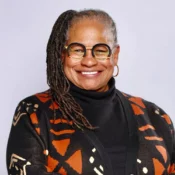
Carolyn Michael-Banks “Queen” is the founder and owner of A Tour of Possibilities (ATOP), an African American historical sightseeing tour of Memphis, TN. She is a native New Yorker who has researched, written scripts, and trained guides in Washington, DC, Savannah, GA, Philadelphia, PA, and Memphis, TN.
Education News

New YA Novel Shows How Fiction Conquers Real Fears in the Age of “Run, Hide, Fight”

“Gone Before You Knew Me” is a satirical spy thriller about a girl trying to make it out of high school alive. The story is fictional, but it speaks to real fears in an age where students and staff are drilled in “run, hide, fight” scenarios as a matter of course.

Why Table Tennis Is Working in NYC Classrooms

As the newly released film “Marty Supreme” brings the world of table tennis into the cultural spotlight, it also quietly parallels a powerful real-life story behind the sport.

Celebrate Love and Kindness with Julie Flett’s Latest Picture Book

From beloved author and illustrator Julie Flett comes an adorable celebration of the ways we show love. For kids up to age 7.

New Report Outlines How Schools Can Prepare for Weather-Related Learning Disruptions

The report draws on lessons from previous disasters to help schools mitigate the impacts to teaching and learning.

Teacher Survey Shows “Zen Zones” Are Far More Desired than AI/Tech Spaces

As conversations about education increasingly center on technology and innovation, many teachers across the country are seeking educational environments that foster a sense of connection and calm for students.

How TRUCE Family Helps Teachers Bring Focus and Calm Back to the Classroom

Educators need a practical solution that protects instructional time and helps students build healthier relationships with their devices. That’s where TRUCE Family comes in.

Advertisement

Read More

What K–12 Schools Must Do in 2026 to Protect Educator Wellness

Educator well-being has suddenly become a buzzword. This isn’t a bad thing—on the contrary, we should have been caring more about the well-being of educators long ago.

Powerful Stories for Black History Month

There’s something profoundly meaningful about engaging with the works of Black authors. Their words invite us to reflect, grow, and better understand one another.

14 Children’s Books That Keep Black History Alive

From activists and abolitionists to history-makers and quiet trailblazers, these books introduce students to lives shaped by perseverance, bravery, and hope.

New YA Novel Shows How Fiction Conquers Real Fears in the Age of “Run, Hide, Fight”

“Gone Before You Knew Me” is a satirical spy thriller about a girl trying to make it out of high school alive. The story is fictional, but it speaks to real fears in an age where students and staff are drilled in “run, hide, fight” scenarios as a matter of course.

Why Table Tennis Is Working in NYC Classrooms

As the newly released film “Marty Supreme” brings the world of table tennis into the cultural spotlight, it also quietly parallels a powerful real-life story behind the sport.

How Two Mounties Taught My Students to Communicate Like Hostage Negotiators

When the RCMP Crisis Negotiation Unit visited my high school law class, I expected some interesting guest speakers. What I didn’t expect was just how profoundly they would change the way my students communicated.