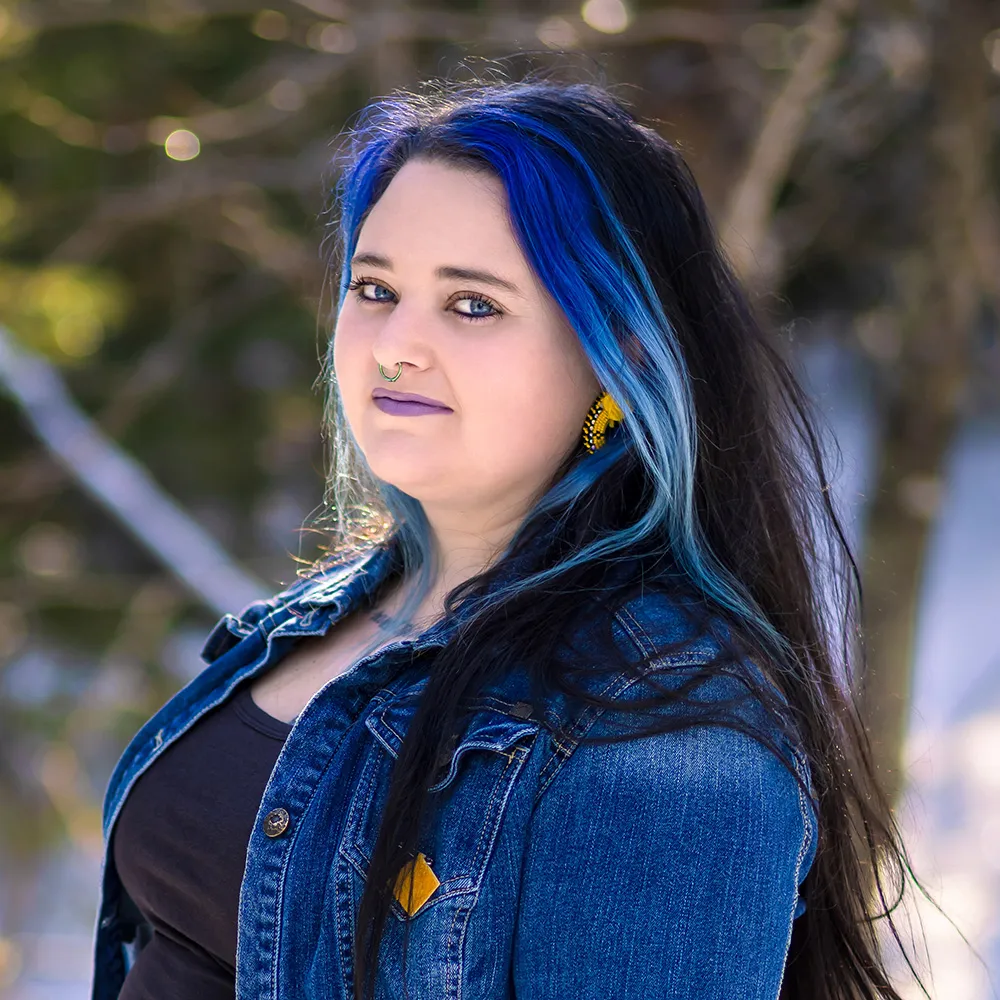
By Willie Poll
For as long as I can remember, I’ve been inspired by stories—in books and on screen, those told through animal tracks in the dirt and howling coyotes at night, or recited around campfires. Legends shared since time immemorial, family tales that bring the past to the present, contemporary narratives of the here and now. Stories of real places and real cultures, and ones of dragon riders and epic battles.
These are what inspired me and shaped the person I have become. They encouraged me to reach for the stars and never give up on my dreams; to be humble and kind and to invest in community.
My name is Willie Poll (she/her) and I’m a Métis author and educator. I am the director of education at the Moose Hide Campaign, an Indigenous innovation to end gender-based violence, and I’m also a judge for the 2025–2026 Kids Write 4 Kids creative challenge—a writing competition for youth to tell their own stories.
There wasn’t a time where I didn’t see myself in stories. I was white, blonde with big blue eyes. Kids like me were the main character in all kinds of books and movies when I was growing up, but even from a young age I questioned their authenticity. Surely there were other voices out there, other tales to be told.
I grew up spending most days with my grandparents. My grandpa, who was both Anishinaabe and Métis, was somewhat of an old cowboy. Adventures of his horses—Gypsy, Gemini, and Flicka—were told daily, with plenty of photographs to accompany them. My grandpa was the hero of my story, a fearless trick rider with a spirit so gentle it was like he and horses spoke the same language. It wasn’t uncommon for there to be an old western playing on the TV at his house, one that portrayed a very different hero (a white cowboy) and a somewhat familiar villain (the Indians).
My grandpa grew up disconnected from his culture and with an abusive addict father. Sometimes I wonder what he thought, if maybe it was easier to see his own people as the villains, since the only connection he had to his Indigeneity was his dad, who was the family villain.
There are things he used to say that have always stuck with me, things that are untrue of our people—things he heard from stories told by colonizers. The history he learned was not ours, but theirs. He didn’t live long enough to see authentic Indigenous voices taking over the bookshelves or TV screens. He wasn’t around to hear Indigenous people tell their stories, and didn’t have the chance to learn many of his own.
I wonder what would have happened if he’d seen an accurate version of himself in the stories he enjoyed, if he’d seen the language, the love, and the strength of Indigenous communities. And then I remember that I am seeing it, in real time. I’m watching my nieces and nephew grow up learning their language, singing their songs, and I recognize the pride in their eyes.
In my work as an educator, I have been fortunate enough to observe youth voices at the forefront. To hear the stories that inspire them and the ones they create to inspire others. In many Indigenous cultures our children are revered as the most important part of our community. Our future. Being part of supporting and amplifying Indigenous youth has been my greatest mission.
As a judge for Kids Write 4 Kids, I also have the opportunity to meet some of our future storytellers—ones who will bring their own authenticity to what they write. This type of storytelling matters. Indigenous voices are not the only ones that have been silenced, ignored, erased, and written over. Haitian stories, Sudanese stories, Chilean stories, and many, many more. Every one of them is important, and there is room for them all.
Bringing these diverse stories into your classroom shouldn’t be a debate. They are merely adding truth to your teaching, and there is so much to be learned from someone’s truth.
In this way, Indigenous stories are what put the “truth” in truth and reconciliation. Not only are such stories a meaningful classroom resource, they are the foundation to a strong Turtle.
Willie Poll is a Métis children’s author and educator who has worked with schools, libraries, and youth across Turtle Island. Originally from Sault Ste. Marie, Ontario, she has lived in many communities—from dog mushing in the Northwest Territories to relaxing on the sandy beaches of Prince Edward Island, where she now resides with her one-eyed pug Queen Puggington and her pony Gandalf.